
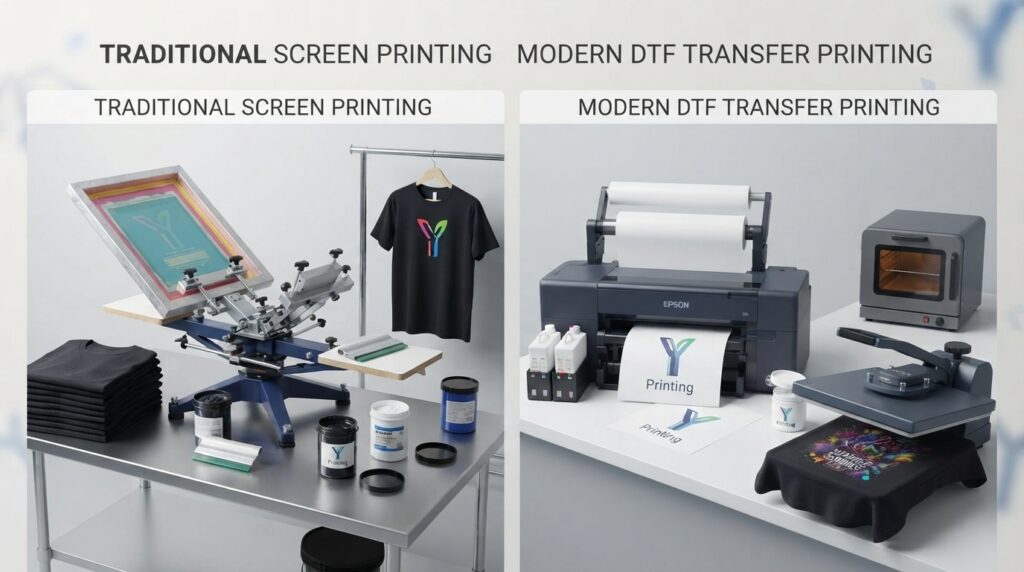
Essential Screen Printing vs DTF Transfers
Which apparel printing method is right for your next order: traditional screen printing or DTF transfers? The answer depends on more than simply comparing the two technologies. Screen Printing vs DTF Transfers involves important differences in setup, artwork, order quantity, color requirements, garment compatibility, and production workflow.
Screen printing has been a trusted apparel decoration method for decades, particularly for larger orders with relatively simple artwork. DTF transfers, meanwhile, provide a flexible digital approach that can handle detailed, full color graphics without requiring traditional screens for each design.
Understanding those differences can help you choose the right process for each project instead of forcing every order through the same workflow. In this guide, we will compare Screen Printing vs DTF Transfers across the factors that matter most, helping you make an informed decision, avoid costly mistakes, and choose the method that makes sense for your business.
Screen Printing vs DTF Transfers: How They Work
Before comparing the two methods, it helps to understand what actually happens during production.
How screen printing works
Traditional screen printing uses a stencil based process. Separate screens are prepared for the colors in a design, ink is pushed through those screens, and the image is transferred onto the garment.
This process requires setup before production begins. The more colors a design contains, the more complicated the preparation can become.
Screen printing is particularly well suited to:
- Large production runs
- Designs with limited colors
- Repeat orders
- Bold logos and graphics
- Customers who prioritize a traditional printed feel
How DTF transfers work
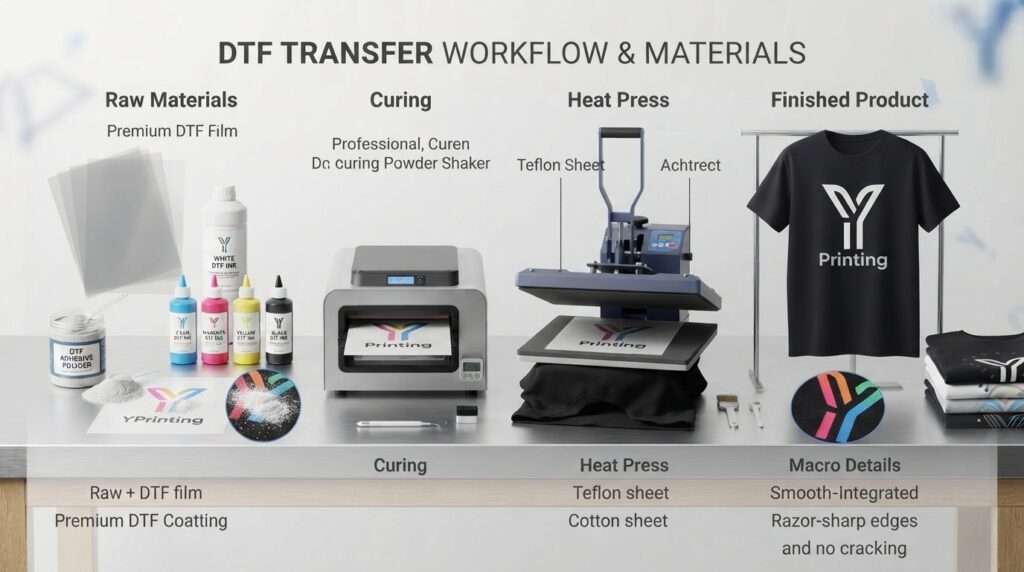
DTF, or Direct to Film, uses a digital printing process. Artwork is printed onto specialized transfer film, adhesive powder is applied, and the transfer is cured before being applied to the garment with a heat press.
The digital workflow makes DTF particularly useful for detailed graphics, gradients, photographs, and designs containing many colors.
DTF can also be used across a broad range of fabrics and apparel products, giving decorators considerable flexibility.
When Screen Printing Is the Better Choice
Screen printing remains an excellent option when the order fits its strengths.
The biggest advantage is often production efficiency once the screens and setup are complete. For a large order featuring the same design, the initial setup can be spread across hundreds or thousands of garments.
Screen printing works well for
Large quantities: If you are producing hundreds of identical shirts, screen printing can become very efficient.
Simple artwork: Logos and graphics using one to a few solid colors are particularly suitable.
Repeat production: Once screens and artwork are established, reordering the same design can be straightforward.
Bold designs: Large, solid graphics can produce the classic appearance many customers associate with screen printed apparel.
However, screen printing becomes less convenient when every shirt requires a different graphic or when the artwork contains complex photographic detail.
When DTF Transfers Are the Better Choice
DTF transfers shine when flexibility and detailed artwork are more important than traditional screen printing workflows.
A major advantage is that digital artwork can contain extensive color variation without requiring a separate traditional screen for every color.
DTF is particularly useful for:
- Small production runs
- Full color artwork
- Photographic designs
- Complex illustrations
- Gradients and shading
- Personalized apparel
- Multiple design variations
- On demand production
Epson’s current DTF workflow, for example, describes printing graphics onto specialty film, applying adhesive powder, curing the transfer, and heat pressing it onto the garment.
This workflow can make DTF especially attractive to small businesses and apparel decorators who need to produce different designs without rebuilding a screen setup for every variation.
Screen Printing vs DTF Transfers for Order Size
Order quantity is one of the most important considerations.
Imagine a customer needs 500 identical shirts featuring a simple three color company logo. Screen printing may be an excellent fit because the setup cost can be distributed across a large number of garments.
Now imagine another customer wants 25 shirts featuring a detailed full color illustration, with several different names and numbers.
That same workflow may favor DTF.
A practical comparison
| Project Requirement | Screen Printing | DTF Transfers |
|---|---|---|
| Large identical orders | Excellent | Good |
| Small orders | Less efficient | Excellent |
| Full color artwork | Possible, but more setup | Excellent |
| Photographic artwork | Limited compared with DTF | Excellent |
| Personalized designs | Less convenient | Excellent |
| Simple logos | Excellent | Excellent |
| Multiple designs | More setup | Very flexible |
| Repeat orders | Excellent | Excellent |
There is no universal winner. The right choice depends on what you are producing and how efficiently you can produce it.
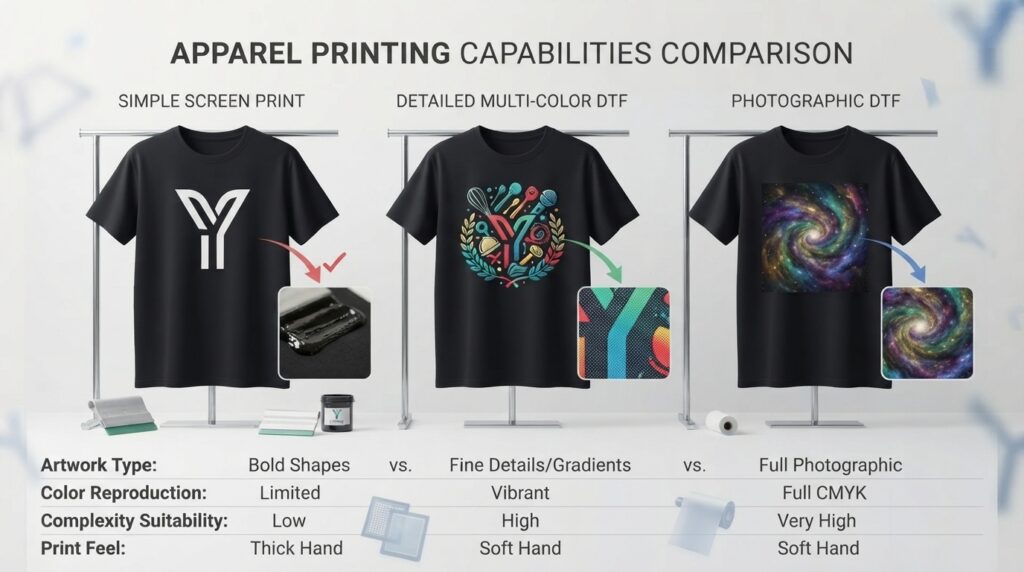
Comparing Artwork and Print Detail
Artwork is another major dividing line in Screen Printing vs DTF Transfers.
Screen printing can create excellent results with bold artwork, but designs containing photographs, subtle gradients, and many color transitions require more complex production.
DTF takes a digital approach, making it well suited to artwork with fine detail and extensive color variation.
That does not mean DTF automatically produces a better looking print. Artwork preparation, ink quality, film, powder, curing, heat press settings, garment selection, and operator technique all influence the final result.
For professional production, consistency across the entire workflow matters just as much as the printing technology itself.
Comparing Garment Flexibility and Production Workflow
DTF can provide significant flexibility when decorating different types of apparel.
Depending on the specific transfer system and materials being used, DTF can be applied to garments made from materials such as cotton, polyester, blends, denim, nylon, and other textiles.
This can be valuable for businesses that produce more than standard cotton T shirts.
A DTF workflow can also allow transfers to be prepared before the final garment is available. Prepared transfers can then be stored and applied later, creating additional scheduling flexibility.
Screen printing has its own workflow advantages, particularly when a shop specializes in repeat production and has established screens, inks, equipment, and procedures.
The best workflow is therefore the one that fits the products you sell most often.
Cost Factors You Should Consider
It is tempting to ask which method is cheaper, but that question is incomplete.
Instead, consider the total production cost.
Screen printing costs can include
- Screen preparation
- Emulsion and exposure
- Ink
- Screens
- Setup labor
- Cleanup
- Flashing or curing
- Garments
- Production labor
DTF costs can include
- Transfer film
- DTF ink
- Adhesive powder
- Printer operation
- Curing
- Heat pressing
- Garments
- Transfer preparation
- Equipment maintenance
For high volume orders, screen printing can become highly efficient because setup costs are distributed over many garments.
For smaller or highly customized orders, DTF can reduce the burden of traditional setup and make short runs more practical.
The important lesson is to calculate your actual cost per finished garment instead of comparing material prices alone.
Choosing the Right Method for Your Business
If you are deciding between these methods for a printing business, start by analyzing your typical customer orders.
Ask yourself:
- How many garments do I normally produce per order?
- Are my designs simple or highly detailed?
- Do customers frequently request personalization?
- How often do I print full color artwork?
- Do I need to support multiple garment materials?
- How quickly do customers expect orders?
- Which equipment and production skills do I already have?
For example, a shop specializing in corporate uniforms with large quantities of simple logos may find screen printing highly effective.
A business producing personalized shirts, small batches, custom artwork, and one off products may find DTF more practical.
And in some businesses, the answer is both.
Using multiple decoration methods allows you to match the production process to the order instead of making every customer fit the same system.
How Y Printing Can Support Your DTF Workflow
For businesses choosing DTF as part of their production strategy, the quality of consumables matters.
Y Printing provides DTF supplies such as DTF film, DTF ink, and polyamide powder, giving apparel decorators access to materials needed for the transfer workflow.
The goal should not simply be purchasing supplies. A reliable production workflow requires consistency between film, ink, powder, curing, heat application, and garment selection.
That is why understanding your materials and documenting successful production settings can help you improve efficiency as your order volume grows.
For customers who do not want to manage every stage internally, custom printing and transfer solutions can also provide another way to incorporate DTF into an apparel business.
Common Mistakes to Avoid
Regardless of which method you choose, several mistakes can hurt profitability.
Choosing based only on price
The cheapest material or process is not necessarily the lowest total cost.
Consider labor, setup, waste, maintenance, production time, and reprints.
Using the same process for every order
A 1,000 shirt order and a 12 shirt personalized order should not necessarily use the same production strategy.
Ignoring artwork requirements
Low resolution artwork can produce disappointing results regardless of the printing method.
Neglecting quality control
Check samples before committing to large production runs, especially when introducing new garments, materials, or settings.
Forgetting production time
A process that looks inexpensive on paper may become less profitable if it requires significantly more labor.
Continue Exploring Y Printing Resources
If DTF looks like the right fit for some of your orders, the next step is learning how the individual components work together.
Start with DTF Transfers to understand how finished transfers can simplify apparel production. For businesses producing transfers themselves, exploring DTF Film Products and understanding the role of film in the printing process can help establish a more consistent workflow.
You can also explore Y Printing’s DTF Ink and Polyamide Powder resources to better understand the materials involved in producing quality transfers.
Together, these resources can help you build a workflow based on the type of apparel and order volume your business actually handles.
Industry References
For additional information about apparel printing technology and industry developments, these resources are worth exploring.
- Epson DTF Printing Technology provides information about current direct to film printing systems, print quality, workflow, and garment applications.
- PRINTING United Alliance provides industry education and coverage of apparel decoration technologies. Recent industry coverage also highlights the continued development of DTF equipment and transfer technologies.
When comparing Screen Printing vs DTF Transfers, there is no single method that is best for every apparel business.
Screen printing remains a powerful choice for high volume orders, repeat production, and bold designs with limited colors. DTF transfers offer exceptional flexibility for detailed graphics, full color artwork, personalization, smaller runs, and varied apparel applications.
The most important decision is not choosing a technology because it is currently popular. It is choosing the workflow that makes your particular orders more efficient and profitable.
For many apparel businesses, that may mean using screen printing for large repeat orders while incorporating DTF transfers for short runs, personalized apparel, and complex artwork.
By understanding the strengths of both methods, you can choose with confidence, reduce unnecessary production costs, and build a more flexible apparel printing operation.
Frequently Asked Questions
Is DTF better than screen printing?
Not universally. DTF is often better suited to small runs, detailed full color graphics, and personalization, while screen printing can be highly efficient for large orders with simpler designs.
Is screen printing cheaper than DTF?
It depends on the order. Screen printing can become very cost effective at high volumes, while DTF can be more practical for smaller orders because it avoids much of the traditional screen setup.
Which method is better for detailed designs?
DTF is generally well suited to detailed artwork, gradients, photographs, and designs with many colors because the artwork is printed digitally onto transfer film.
Can DTF replace screen printing?
DTF can replace screen printing for some types of orders, but it does not eliminate the advantages of screen printing. Many apparel businesses can benefit from offering both methods.
Is DTF good for small orders?
Yes. DTF is particularly useful for small runs and personalized apparel because the digital workflow allows different designs to be produced without creating a traditional screen setup for every design. Industry transfer guidance similarly identifies DTF as well suited to small runs and full color artwork.